
Imagine this. You’ve had one of those days. The commute was a nightmare, your brain is fried, and all you want is to just collapse on your couch. You walk through your front door, drop your keys in the bowl, and just say, “Hey, I’m home.”
Instantly, the entryway lights fade into a warm, welcoming glow. You hear the soft click of the thermostat as it kicks on, adjusting the temperature from energy-saving mode to your perfect degrees. In the living room, your favorite “chill after work” playlist starts to play softly from the speakers. This isn’t some far-off scene from a sci-fi movie.
This is the reality of the smart home, and it’s happening right now. In 2024, there are 69.91 million homes in America that use smart home devices. And more people are buying them every day because they’re getting cheaper and much easier to use.
The mix of AI in smart homes and voice control is totally changing how we live at home. It started with just basic stuff like “turn on lights,” but now we have smart systems that really understand what we want and when we want it.
The Smart Home Boom Is Real, and It’s Happening Now
It feels like just yesterday that “smart devices” were a niche hobby for tech enthusiasts who loved to tinker. Now, you can’t walk through a Best Buy or browse Amazon without seeing them everywhere. And people are buying them. The number of people using voice assistants for smart homes in the US is going to go from 36.6% in 2022 to about 46.9% by 2025. That shows how fast Americans are getting into voice-controlled home automation.
The reason is simple: it’s getting cheaper and way, way easier. The mix of AI in smart homes and intuitive voice control has completely changed the game. What started with complex apps and complicated setups is now as simple as talking. We’ve moved beyond basic commands into a world where our homes are starting to understand us.
How AI Voice Assistants Work in Smart Homes

It’s easy to think of this tech as just… magic. You talk to a little speaker, and stuff happens. But what’s going on behind the scenes is a whole different ballgame, and it’s why companies are pouring an insane amount of money into it.
According to Market.us report, Voice AI in Smart Homes Market is projected to hit a mind-boggling $514.62 billion by 2034. That’s a compound annual growth rate of 44.8%. Early voice commands were like teaching a dog. You say “sit,” and it sits. You say “turn on lights,” and it turns on the lights. It only understands specific keywords. Modern AI home automation is like having a human personal assistant.
It uses something called Natural Language Processing (NLP) to figure out the context and what you actually mean, not just the words you said. It can even tell the difference between your voice, your spouse’s voice, and your kid’s voice, customized its response to whoever is talking.
Cool AI Features That Are Changing Everything
Okay, so we know it’s smart, but what does that mean for you day-to-day? This is where the “wow” factor comes in. The latest AI features are less about simple commands and more about creating an environment that feels like it’s perfectly in sync with your life.
It Understands What You
Modern AI voice systems have gotten incredibly good at parsing complex requests. They use advanced voice command technology that can deconstruct a whole string of thoughts.
For example, you can come in the door and say, “Hey Google, turn off all the lights except the one in the kitchen, set my work alarm for 7 AM, and can you remind me to take out the trash tomorrow morning?”
The AI doesn’t get confused. It processes each part of that sentence as a separate task and executes them all seamlessly.
It Learns Your Life and Predicts Your Needs
This is probably the coolest, and slightly spooky, part of home automation using artificial intelligence. These systems are designed to learn. Machine learning algorithms are constantly and silently analyzing patterns.
For example, you might notice that every weekday around 9 PM, you dim the living room lights, lower the thermostat by two degrees, and turn on the TV. After a week or two of this, the system will start suggesting these actions for you. Eventually, it might just do them automatically, creating a “movie time” scene without you ever having to ask.
This predictive capability, fuelled by AI integration with sensors, your usage habits, and even external data like the weather, creates a home that adapts to you, not the other way around. It’s like having a butler who pays close attention.
It Makes All Your Different Gadgets Play Nice
One of the biggest headaches of early smart homes was getting devices from different companies to work together. AI is finally solving this.
The AI acts as the central conductor of this complex orchestra, understanding what each device can do and coordinating them to work together in perfect harmony.
Benefits of Voice-Controlled AI Home Automation
All this tech is impressive, but does it make life better? You bet. Let’s move from the theory to how people are using this stuff to solve real, everyday problems.
- Saving Serious Energy (and Cash): Let’s be honest, we all want to lower our energy bills. AI home automation is a powerful tool for this. Instead of just setting a rigid schedule, a smart thermostat with voice control can make real-time, intelligent decisions. A study by the American Council for an Energy-Efficient Economy (ACEEE) found that smart thermostats can help homeowners save anywhere from 10% to 20% on heating and cooling costs.
- Next-Level Security That’s Genuinely Smart: Home security systems have become incredibly sophisticated thanks to AI. The Grand View Research report estimates the smart home security market at around USD 33.94 billion in 2024, growing to USD 40.46 billion in 2025. It’s no longer just about alarms and sensors. Now, you can give nuanced commands.
- A Lifeline for Independence and Aging in Place: This might be the most impactful use of all. For elderly individuals or people with mobility issues, AI voice control is a life-changing technology. Simple tasks like getting up to turn off a light, adjust the thermostat, or find a TV remote can be difficult or even dangerous. Voice commands remove those physical barriers entirely.
Leading Voice Assistant Platforms in AI-Powered Smart Homes

Three major players dominate the AI voice control landscape, each with a slightly different philosophy.
- Amazon’s Alexa: Think of Amazon’s Alexa as the universal connector. Its biggest strength is its sheer size. The Alexa platform supports over 140,000 smart home devices from thousands of different manufacturers. If a smart device exists, it probably works with Alexa. Amazon’s focus is on creating a vast, open ecosystem where everything can connect.
- Google Home: Google’s advantage is its brain. The Google Home automation system leverages the company’s unparalleled strength in AI and search. Google Assistant is exceptionally good at understanding natural, conversational language and answering complex questions. Its AI integration with your Google Calendar, Maps, and Gmail allows for some uniquely powerful predictive automations based on your actual life schedule.
- Apple’s HomeKit: Apple’s approach can be summed up in one word: privacy. Apple’s HomeKit platform is built around smart home privacy features. It prioritizes processing commands locally on your devices (like an Apple TV or HomePod) instead of sending them to the cloud. This, combined with end-to-end encryption, appeals to users who are wary of their data being collected. The ecosystem is more of a “walled garden” and supports fewer devices, but the ones it does support work flawlessly and securely.
Common Challenges With AI Voice-Controlled Home Devices
It’s not all sunshine and perfectly brewed coffee. As with any new technology, there are bumps in the road. It’s important to go in with your eyes open.
- Privacy and Data Security: This is the elephant in the room. The idea of an “always-listening” device in your home is unsettling for many. You have to trust the company behind your smart speaker. While companies are getting better with more transparent data policies and on-device processing, it’s still a valid concern. You’re making a trade-off between convenience and privacy.
- Compatibility Headaches: While AI is helping devices play nice, it’s not a perfect world. You can still run into situations where your new smart lock doesn’t want to talk to your existing smart hub. Different wireless standards (like Zigbee, Z-Wave, and Wi-Fi) can sometimes cause frustrating compatibility issues.
- The Accuracy Problem: We’ve all been there. You ask your assistant to do something, and they get it completely wrong. While accuracy has improved dramatically, things like strong accents, background noise, or just mumbling can still trip up the AI. A false activation in the middle of the night or a misunderstood command can be more frustrating than just flipping the switch yourself.
The Future of AI Voice Control in Smart Home Technology
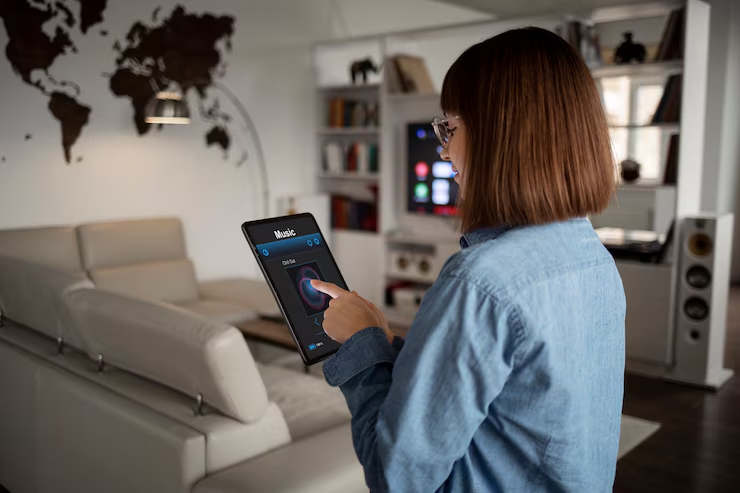
The integration of AI and voice control in home automation is more than just a cool trend; it’s a fundamental shift in how we interact with our living spaces. The number of digital voice assistants in use is expected to double to 8.4 billion by 2024. That’s more assistants than there are people on the planet. A voice-controlled home is rapidly becoming the norm, not the exception.
The future promises homes that don’t just respond but anticipate. Homes that understand context, learn our moods, and actively work to make our lives easier, safer, and more efficient. With costs falling and capabilities growing every single day, the question for homeowners is no longer if they should adopt AI-powered voice control but how quickly they want to embrace a smarter way of living. The revolution is just getting started.
Leave a Reply